Buying quality hay is an investment in your horses, cattle, goats, and other livestock. Whether you purchase a few bales at a time or stock your barn with enough hay to last for months, proper storage can make a major difference in how much of that investment ultimately makes it into your animals’ feeders.
So, how long can hay actually be stored without losing quality?
When hay is properly harvested, thoroughly dried, and protected from moisture, it can generally be stored for a year or longer while retaining much of its feeding value. However, hay does not remain exactly the same forever. Nutritional changes gradually occur during storage, and poor storage conditions can cause deterioration much faster.
For farms in Florida, storage is especially important. Our combination of heat, humidity, and frequent rainfall can make moisture management challenging. Understanding what causes hay to deteriorate can help you keep your supply fresh, usable, and nutritious for as long as possible.
Does Hay Have an Expiration Date?
Hay does not have a specific expiration date like many packaged feeds and food products. Instead, its usable life depends largely on how it was produced and stored.
High-quality hay that was baled at an appropriate moisture level and stored inside a dry, well-ventilated structure can remain usable well beyond a year. Research has shown that properly stored hay may experience relatively small dry-matter losses even after 12 to 18 months compared with hay exposed to the weather.
That does not mean a two-year-old bale will necessarily have exactly the same nutritional profile it had when it was freshly harvested. Some nutrients decline over time, and older hay should be evaluated before being incorporated into an animal’s diet.
The bigger concern is usually not age itself. It is moisture.
Hay that stays dry can last a surprisingly long time. Hay repeatedly exposed to rain, ground moisture, condensation, or excessive humidity can deteriorate considerably faster.
How Long Does Hay Last in a Barn?
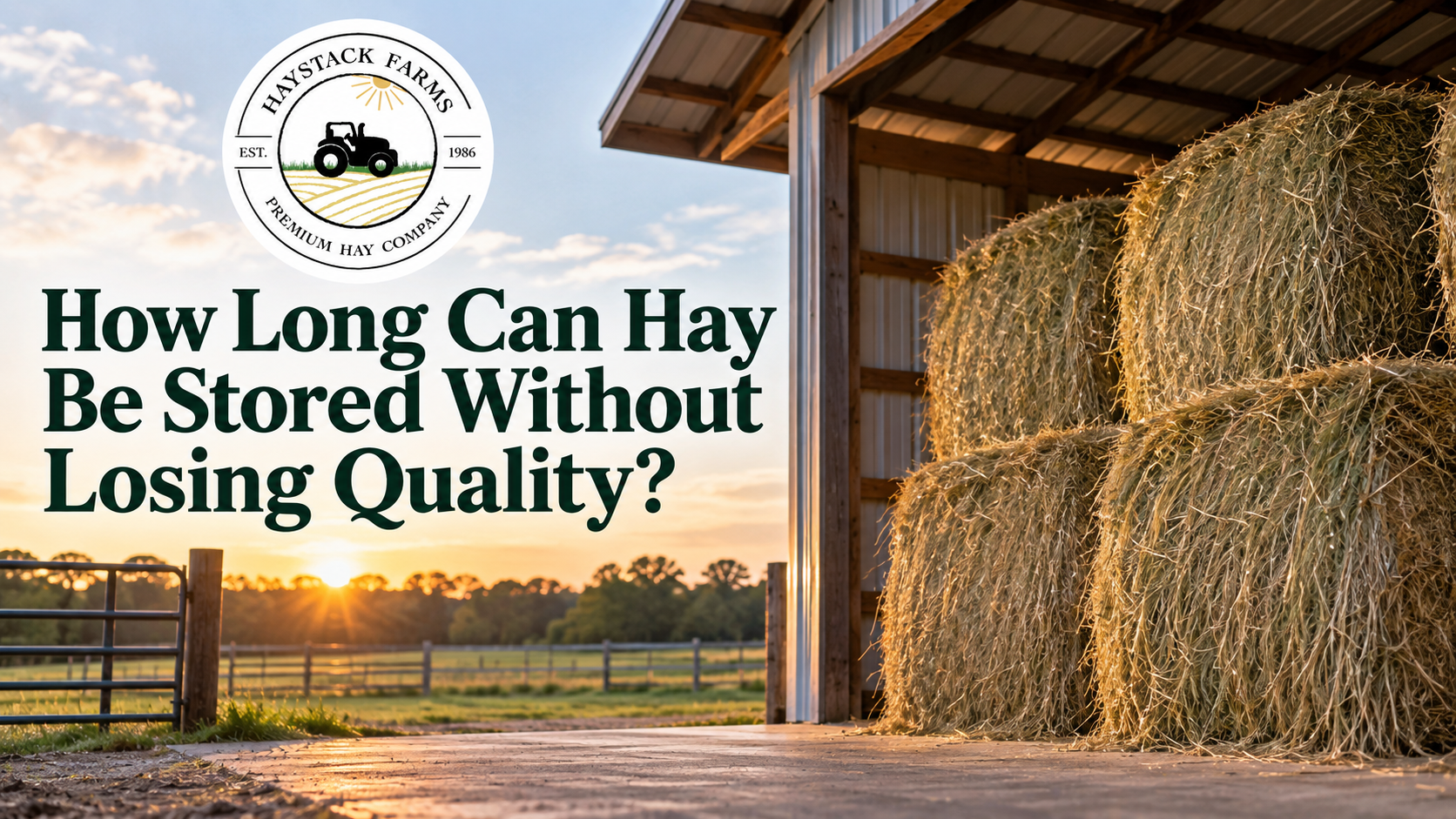
For most farms, storing hay under a roof is one of the best ways to preserve its quality.
Hay stored in an enclosed barn and protected from moisture can commonly be kept for 12 months or longer. Research summarized by agricultural extension programs has found dry-matter losses from enclosed barn storage can remain very low compared with outdoor storage.
This is especially valuable when purchasing hay in bulk.
A barn protects hay from direct rainfall and reduces exposure to the elements, but simply putting hay inside a building does not automatically guarantee perfect storage conditions.
The barn itself needs to stay dry.
Roof leaks, standing water, poor drainage, and excessive condensation can all introduce moisture. Hay should also be stored in a way that promotes ventilation rather than trapping moisture inside tightly packed areas.
In Florida’s humid environment, keeping the storage area dry and allowing adequate airflow is particularly important.
What Happens to Hay as It Gets Older?
Hay can gradually lose some nutritional value during storage even when it remains visually acceptable.
One nutrient particularly affected by extended storage is carotene, which is a precursor to vitamin A. Other changes can occur depending on the type of forage, initial hay quality, moisture level, temperature, and storage environment.
However, the most significant deterioration usually happens when moisture allows molds and microorganisms to become active.
These organisms consume nutrients contained in the hay. As a result, improperly stored hay may experience both a reduction in the amount of usable dry matter and a reduction in overall feeding value.
This is why the difference between “old hay” and “bad hay” is important.
Hay that has simply been stored for an extended period is not automatically bad. Hay that has become wet, moldy, excessively dusty, or contaminated is a different matter.
Moisture Is Hay’s Biggest Storage Enemy
If you want hay to last, keeping it dry should be your top priority.
Hay containing too much moisture when it is baled can begin heating as microorganisms become active. Extension guidance commonly recommends keeping dry hay below approximately 20% moisture for storage, with lower moisture levels often preferred depending on bale type and conditions.
Excessive moisture can lead to mold growth, nutrient losses, discoloration, reduced palatability, and heating.
In severe cases, improperly cured hay can even become a fire hazard.
Moisture can also enter hay after baling.
This is particularly important in Florida, where rainfall and humidity can make outdoor hay storage difficult. A bale sitting directly on damp soil can absorb moisture through its bottom. In fact, agricultural research has repeatedly shown that the area where a bale contacts the ground can account for a substantial portion of storage losses.
Keeping hay dry therefore means protecting it from moisture both above and below.
How Long Can Hay Be Stored Outside?
Outdoor hay storage is possible, but the length of time hay maintains its quality can be significantly shorter.
Uncovered hay stored directly on the ground is particularly vulnerable. Depending on rainfall, humidity, bale density, forage type, and storage duration, losses can become substantial.
Studies of round-bale storage have found dry-matter losses ranging from relatively modest amounts to more than 30% during long-term outdoor storage. In wet climates, losses can be even more severe.
Florida’s climate makes these concerns especially relevant.
If hay must be stored outdoors, choosing a well-drained location is extremely important. Bales should not sit directly on wet soil. Gravel pads, pallets, or another suitable elevated surface can help reduce moisture absorption from below.
A properly secured waterproof cover can provide additional protection.
Round bales stored outside should generally be arranged to encourage drainage and airflow. Leaving adequate space between rows also helps sunlight and air reach the bales after rainfall.
Outdoor storage should generally be viewed as a way to manage hay that will be used sooner rather than as the ideal solution for maintaining premium-quality hay over a long period.
How Can You Tell If Stored Hay Is Still Good?
Before feeding hay that has been stored for an extended period, inspect it carefully.
Good hay should generally have a pleasant forage smell rather than a musty or sour odor. While color naturally fades during storage, unusual dark areas or obvious patches of mold deserve attention.
Pay particular attention to the center and bottom of the bale rather than judging the entire bale by its exterior.
Some weathering on the outside of a round bale does not necessarily mean the entire bale is ruined. However, moisture can penetrate farther than expected, especially when a bale has been sitting outside for months.
Dust is another consideration. Extremely dusty or moldy hay can be problematic, particularly for horses and animals with sensitive respiratory systems.
When nutritional value is important, appearance alone cannot tell you everything.
A forage analysis is the best way to determine the actual nutritional content of stored hay. Testing becomes particularly useful for larger operations, performance horses, breeding animals, or livestock with specific nutritional requirements.
Does Hay Lose Quality After One Year?
Some nutritional changes should be expected after extended storage, but reaching the one-year mark does not suddenly make hay unusable.
Properly stored hay can retain considerable feeding value beyond a year.
The difference between well-stored and poorly stored hay after 12 months, however, can be dramatic.
Research comparing storage methods has found that large round bales stored in enclosed barns may experience only a small percentage of dry-matter loss over 12 to 18 months. Exposed bales stored directly on the ground can experience losses several times greater.
In other words, where you store hay can matter more than exactly how old it is.
A well-protected bale from last season may be in substantially better condition than a much newer bale that has spent months sitting on wet ground in the Florida rain.
Should You Use Older Hay First?
Yes. Rotating your hay inventory is one of the simplest ways to reduce waste.
When new hay arrives, avoid automatically placing it where it will be used before the older supply. Organize your storage area so older hay can be fed first while it is still in good condition.
This is essentially the same “first in, first out” inventory system used for many agricultural products.
Labeling hay by cutting, delivery date, field, or variety can also help larger farms keep track of inventory.
This becomes particularly useful when storing several types of hay, such as Coastal Bermuda, Jiggs, Tifton 85, or Perennial Peanut hay.
How to Make Your Hay Last Longer
Long-term hay quality starts before the bales ever reach the barn. Hay needs to be properly harvested, cured, and baled at an appropriate moisture level.
Once you receive it, focus on keeping moisture away.
Store hay under a sound roof whenever possible. Keep the storage area well drained and address roof leaks quickly. Avoid placing hay where rain can blow directly onto it or water can accumulate after storms.
When appropriate, keeping the bottom layer separated from potentially damp surfaces can provide additional protection.
Ventilation also matters. Hay storage buildings should allow heat and moisture to escape rather than creating a damp environment.
Finally, inspect your hay periodically. Finding a leaking roof or moisture problem early can save dozens or even hundreds of bales from unnecessary deterioration.
Florida Farms Need to Pay Extra Attention to Hay Storage
Florida is an excellent place to grow forage, but our climate presents unique storage challenges.
Warm temperatures, high humidity, heavy thunderstorms, tropical weather, and long periods of moisture can accelerate deterioration when hay is not adequately protected.
UF/IFAS guidance notes that weathering of stored hay is encouraged by rainfall, humidity, and high temperatures. For Florida farmers and horse owners, that makes good storage practices especially valuable.
If you purchase hay in larger quantities, planning your storage before delivery can help protect both the hay and the money you’ve invested in it.
Quality Hay Starts With a Quality Supplier
Even the best storage system cannot improve hay that was poorly produced in the first place. Long-term quality begins with properly grown, harvested, cured, and baled forage.
At Haystack Farms, we understand how important dependable hay is for farms, horse owners, feed stores, and livestock operations. We produce quality hay varieties including Coastal Bermuda, Jiggs, Tifton 85, and Perennial Peanut hay to meet a variety of feeding needs.
Whether you’re purchasing hay for a few animals or planning bulk hay needs for a larger operation, starting with quality forage and storing it correctly can help you get the most value from every bale.
Hay may not have a strict expiration date, but storage conditions make all the difference. Keep it dry, protect it from Florida’s weather, rotate older inventory first, and inspect stored hay regularly. With proper care, quality hay can remain a valuable part of your feeding program for a year or longer.